Gimbal Technology has moved beyond film sets. It now supports drones, smartphones, industrial inspection, live broadcasting, and precision imaging. Global buyers therefore face more than a simple stability decision. Payload limits, motor torque, battery life, weather resistance, software compatibility, and after-sales service can determine whether a purchase succeeds.
Industry reports show strong demand, but their market estimates differ. MarketsandMarkets and Grand View Research both identify camera stabilizers as a growing segment, driven by content creation, aerial imaging, and professional video production. These reports also reveal an important limitation. Market categories are not always consistent. Some include handheld stabilizers, while others count robotic and aerial systems separately. Buyers should inspect the methodology before trusting a headline figure.
As filmmaker and stabilization specialist Vincent LaForet has said, “The best camera movement is the one the audience never notices.” That principle still matters when comparing modern Gimbal Technology. A smooth test shot is useful. It is not enough. Buyers should test the system with their actual camera, lens, microphone, and accessories. Check balance time, operating temperature, control latency, and replacement-part availability. Ask for regional service commitments in writing.
Small details matter.
A lightweight gimbal may reduce operator fatigue, yet sacrifice payload capacity. A feature-rich model may create a steeper training burden. No checklist is perfect. The following ten buying tips help global purchasers compare technical performance, supplier reliability, total ownership cost, and practical field experience before committing to a specification.
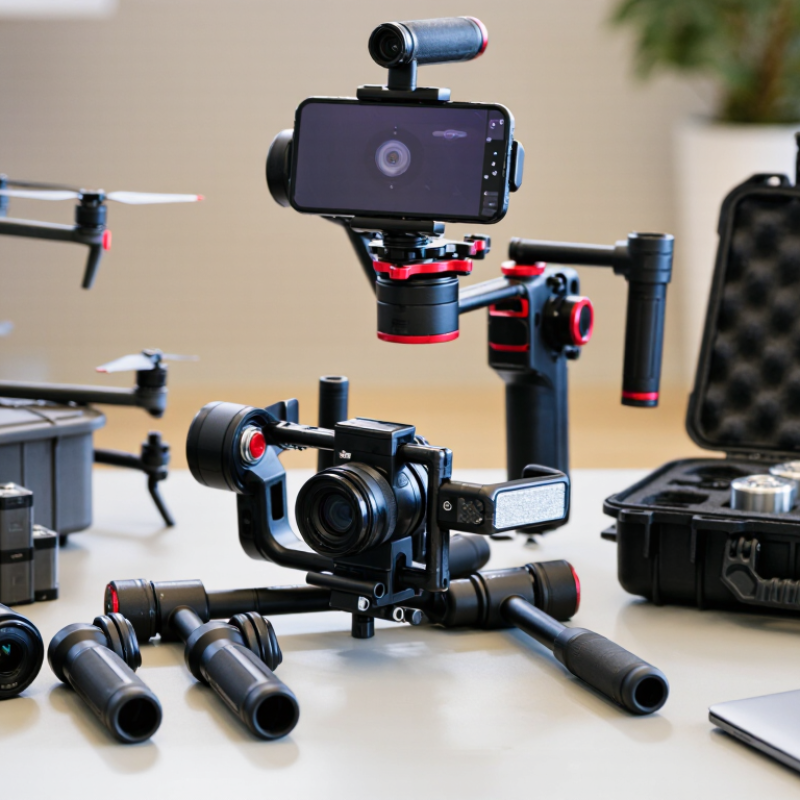
Global buyers should match gimbal types with operating conditions, not only camera weight.
Handheld gimbals suit interviews, travel, and fast-moving creators.
Aerial gimbals need low weight, vibration isolation, and reliable remote control.
Vehicle or industrial gimbals require stronger housings, longer duty cycles, and stable mounting.
Three-axis stabilization usually provides smoother footage, but it consumes more power and increases maintenance points.
6%
A 2024 Grand View Research assessment forecasts the camera gimbal market to grow at roughly 6% annually through 2030.
Demand is expanding, but specifications still vary sharply by region.
Check payload capacity with the lens, battery, and accessories installed.
Do not trust the camera body weight alone. Measure startup time, balancing range, motor temperature, and usable battery hours.
Request test footage from walking, panning, and sudden stops. Small details matter.
For outdoor work, review the IP rating, operating temperature, wind tolerance, and salt-fog resistance.
According to the 2024 Drone Industry Insights report, commercial drone activity continues to expand across inspection and mapping, increasing demand for lightweight, dependable imaging systems.
However, buyers should verify local radio approvals, battery transport documentation, and electromagnetic compatibility requirements before shipment.
A perfect specification rarely exists.
I would also budget for firmware support, spare motors, training, and regional repair access.
Many purchasing teams forget those costs.
That mistake can make a low-priced gimbal expensive within one year.
When global buyers evaluate gimbal technology, stabilization should be measured, not assumed. Ask whether the system uses three-axis control and compare its settling time after a sudden movement. Review angular accuracy, vibration tolerance, and performance during slow pans. A smooth demonstration may hide poor results in wind or on uneven vehicles. Field tests matter more than polished specifications.
Tips: Match the rated payload with your complete camera, lens, cable, and accessory weight. Check the center of gravity, not only the maximum load. Confirm compatible mounting interfaces and balancing procedures. Evaluate motor torque, response speed, and operating noise. A heavier payload can reduce battery life and create heat. That detail is often overlooked. Ask for test conditions, sample footage, and repeatable measurement methods.
Performance also depends on power, software, and environment. Verify runtime at the intended payload, then examine charging options and backup power requirements. Check operating temperatures, dust and moisture protection, and transport durability. Confirm whether remote control, data output, and firmware updates fit your workflow. Request service intervals and replacement-part availability in your region. I have found that small calibration errors can ruin otherwise strong footage. Specifications can be incomplete, too. Leave room for independent testing before committing to a large purchase.
Global buyers should treat compatibility as a system question, not a specification checkbox. Check payload weight, mounting patterns, camera dimensions, and available control interfaces together. A gimbal may support the required load but still fail because its center of gravity is unsuitable. Measure twice.
Power requirements deserve equal attention. Confirm input voltage, peak current, startup demand, and connector polarity before ordering. A power supply rated for average consumption may collapse during rapid movement. Power matters. I once saw a field test fail because a compact adapter overheated inside a sealed enclosure. That small oversight delayed installation and changed the enclosure design.
System integration should be tested with the actual controller, software, cables, and network conditions. Verify command protocols, update methods, response latency, and data output formats. Test it early. Leave physical space for cable bends and maintenance access, especially in mobile platforms. Environmental details also matter, including vibration, dust, humidity, and temperature changes. Request clear technical drawings and documented test results from suppliers. However, do not accept every figure without questioning its test conditions. A laboratory result may not represent a windy rooftop or a vehicle moving over uneven ground. Build a simple integration prototype before committing to a large purchase.
Global buyers should treat a gimbal as a safety-critical electromechanical assembly, not merely a stabilizer. In field evaluations, weak hinges, exposed cable exits, and loose motor mounts often appear before electronic faults. Ask for cycle-test records, drop-test conditions, and torque limits. IEC 60529 ratings describe water and dust resistance under defined laboratory conditions. An IP54 label does not prove survival against rain, salt mist, or repeated cleaning. Request the test report, not just the certificate.
Durability evidence must match the destination market. IEC 62368-1 can guide audio and video equipment safety, while battery-powered units may require UN 38.3 transport testing. Radio-enabled models can trigger FCC rules in the United States, RED requirements in the European Union, and equivalent local approvals elsewhere. Requirements vary by radio band, charger, battery, and intended use. The European Commission’s Safety Gate 2023 report logged more than 3,400 product alerts, showing why supplier declarations deserve verification.
Compare materials, sealing, thermal performance, and repair access, not phrases such as professional grade. ISO 9227 salt-spray data can help assess corrosion resistance, although it cannot reproduce every coastal environment. Ask whether test samples were production units. This detail matters. A polished report may hide a weak connector. Verify firmware controls, fail-safe behavior, and battery protection during stalled-motor tests. No checklist is perfect; procurement teams should record assumptions and revisit them after pilot use.
| Tip | Buying Dimension | Relevant Fact or Benchmark | Regional Compliance Consideration | Recommended Buyer Check |
|---|---|---|---|---|
| 1 | Payload and balance capacity | Verify the supported camera-and-lens mass, mounting dimensions, and center-of-gravity range. A listed payload is not a substitute for a balance test. | No universal regional payload rule applies; workplace risk assessments may still require documented load limits. | Test the heaviest intended setup in every operating mode, including external monitors, microphones, and batteries. |
| 2 | Mechanical durability | Assess hinge wear, locking mechanisms, motor bearings, connector strain relief, and the stated operating temperature range. These features directly affect field reliability. | If used in the European Economic Area, product safety documentation should support the applicable requirements of the General Product Safety Regulation and other applicable legislation. | Request endurance-test methods, cycle counts, temperature limits, and service procedures rather than relying only on marketing terms. |
| 3 | Ingress and environmental protection | An IP code is defined by IEC 60529. The first digit addresses solid-particle protection and the second addresses water protection; an IP rating does not automatically prove shock or corrosion resistance. | Use the IEC 60529 test report for international comparison, while checking whether local procurement rules require additional environmental testing. | Confirm the exact IP level, test conditions, connector covers, and whether the rating applies while the device is operating or only when stored. |
| 4 | Battery safety and transport | Rechargeable lithium batteries are commonly evaluated against IEC 62133-2 for portable applications, while UN 38.3 covers transport-related testing for lithium cells and batteries. | Air and sea shipments may require UN 38.3 test summaries, watt-hour labeling, packaging controls, and transport declarations under applicable dangerous-goods rules. | Obtain the battery chemistry, rated watt-hours, protection features, IEC 62133-2 evidence where applicable, and UN 38.3 test summary before shipment. |
| 5 | Electrical and charging safety | Check over-charge, over-discharge, short-circuit, over-temperature, and abnormal-operation protections. USB charging capability does not by itself prove electrical safety. | The required assessment may differ for the gimbal, power adapter, and battery pack. The European Union, United Kingdom, United States, and other markets use different conformity routes. | Request electrical safety reports, charger specifications, input-voltage limits, and separation of approvals for the device and supplied adapter. |
| 6 | Electromagnetic compatibility | Brushless motors and wireless circuits can generate or receive electromagnetic interference. EMC testing should cover emissions and immunity under normal operating modes. | Typical market routes include the EU EMC Directive 2014/30/EU, United States FCC Part 15 requirements for applicable digital or radio devices, and other national schemes. | Ask for test reports matching the exact model, radio functions, firmware configuration, and intended destination market. |
| 7 | Wireless and radio functions | Bluetooth, Wi-Fi, or other radio modules can require separate radio-frequency, EMC, and human-exposure assessments depending on their configuration and use. | The EU Radio Equipment Directive 2014/53/EU may apply to radio equipment; the United States generally uses FCC equipment authorization; other jurisdictions have their own approval systems. | Confirm supported frequency bands, maximum transmit power, module approvals, labeling, and whether firmware can change radio parameters. |
| 8 | Chemical and material restrictions | Material declarations should address restricted substances in electronic components, cables, coatings, plastics, and batteries. | For the EU market, RoHS Directive 2011/65/EU and its amendments may apply to electrical and electronic equipment; REACH obligations may also be relevant. | Request a current declaration of conformity, restricted-substance declaration, and supplier material documentation for the exact product revision. |
| 9 | Battery end-of-life obligations | A removable battery can simplify replacement and recycling, while an integrated battery may increase service complexity and disposal requirements. | The EU Batteries Regulation 2023/1542 introduces requirements covering batteries and products containing batteries, including labeling and producer responsibilities in applicable cases. | Check battery replacement instructions, recycling symbols, local producer-registration duties, and the availability of spare batteries. |
| 10 | Documentation and regional marking | A genuine compliance package should identify the exact model, applicable standards, test dates, responsible economic operator, user instructions, and electrical ratings. | CE marking may apply in the European Economic Area, UKCA may apply in Great Britain for relevant regulated products, and the United States uses market-specific FCC and safety requirements rather than one universal mark. | Map every destination country before purchase and verify that labels, manuals, declarations, plug types, and importer information match the shipment. |
Note: Regulatory requirements depend on the product configuration, battery design, wireless features, accessories, and destination country. Confirm the current requirements with the relevant authority or qualified compliance specialist before importation.
Tip: Assess a gimbal supplier beyond its product page. Request test videos, factory inspection records, and component traceability. Ask how the supplier handles calibration errors after delivery. A reliable team should explain payload limits, stabilization accuracy, and environmental ratings clearly. Vague answers deserve caution. During supplier calls, note response times and technical detail. Fast replies are useful, but accurate replies matter more.
Tip: Calculate the total cost before comparing quotations. Include shipping, import duties, spare batteries, training, software updates, and installation. A low unit price can become expensive after customs clearance. Ask for a three-year ownership estimate. I have seen buyers overlook replacement cables and mounting accessories. That small omission changed the budget significantly. Leave room for unexpected repairs.
Tip: Read the warranty like an engineer, not a marketer. Check coverage periods, excluded damage, return procedures, and repair turnaround times. Confirm whether warranty service requires overseas shipping. That delay may interrupt filming or inspection work. Ask for a written after-sales process with named contacts and escalation steps. Response targets should be practical, not merely promised. A local service partner can reduce downtime, though its technical ability should be verified. Test one support request before placing a large order. It may reveal weaknesses early.
Match the gimbal to the operating environment, not just camera weight. Handheld models suit travel and interviews. Aerial models need low weight and vibration isolation. Vehicle-mounted models need strong housings and stable mounting.
Weigh the complete setup, including the camera, lens, battery, cables, and accessories. Do not measure the camera body alone. Check the center of gravity, too.
Three-axis control usually creates smoother footage during walking, panning, and sudden stops. It also consumes more power and adds maintenance points. Smoothness has a cost.
Request footage from walking, slow panning, uneven movement, wind, and sudden stops. Measure settling time, angular accuracy, motor temperature, and response speed. Polished demonstrations can hide weaknesses.
Heavier payloads can shorten runtime, increase heat, and reduce motor response. Test battery hours with the intended camera setup installed. Rated capacity can be optimistic.
Check the IP rating, operating temperature, wind tolerance, dust protection, and salt-fog resistance. Transport durability also matters. Small details matter.
Verify local radio approvals, battery transport documents, and electromagnetic compatibility requirements. Confirm regional rules before shipping. Requirements vary sharply.
Budget for firmware support, spare motors, training, service intervals, and regional repairs. Confirm replacement-part availability. That cost hurts.
Check remote control, data output, charging options, backup power, and firmware updates. Confirm compatibility with the intended workflow. I would still test everything independently.
Compare repeatable field measurements, sample footage, and complete ownership costs. Leave time for independent testing before a large purchase. Perfect specifications rarely exist.
Choosing the right Gimbal Technology requires global buyers to evaluate more than basic stabilization performance. Start by identifying the appropriate gimbal type for the intended application, then compare stabilization accuracy, payload capacity, movement range, response speed, and operating reliability. Compatibility with cameras, sensors, control systems, mounting structures, and communication interfaces is equally important. Buyers should also confirm power requirements, battery options, environmental protection, and ease of system integration before making a decision.
Durability and safety should be assessed through materials, testing procedures, operating temperature ranges, and relevant regional compliance requirements. A complete purchasing evaluation should include supplier experience, production consistency, customization capability, lead times, shipping considerations, and total ownership costs rather than focusing only on the initial price. Clear warranty terms, spare-part availability, technical documentation, training, and responsive after-sales support can significantly reduce long-term risks. By reviewing these factors together, international buyers can select a practical, dependable, and cost-effective solution that matches their operational needs.

Yaftech Motor